
Dendritic Cell Vaccine for Glioblastoma: What Patients Should Know
Access to Certified Immunotherapy Clinics in Germany
With Germany Health you find the best leading clinics for dendritic cell vaccine for glioblastoma treatment in Germany. Dendritic cell therapy for glioblastoma is available at clinics and centers with certification and license only.
We offer only hand-picked, certified, and trusted clinics for the treatment of glioblastoma with comprehensive immunotherapy for glioblastoma.
Today, the German clinic offers a high standard of medical care. The doctors there have 20+ years of experience treating patients in Germany with dendritic cell immunotherapy. Get all by one hand organized through GermanyHealth.
Therapies that enhance the body’s natural methods of fighting cancer are being studied by scientists around the world. Unfortunately, cancer is the leading cause of premature death. Yet only two Nobel Prizes in Medicine have been awarded to cancer researchers in the last 15 years – both for immunotherapy (2011 R Steinman, 2018 P Allison, and T Honjo).
If there’s any hope in the fight against glioblastoma, it’s in the treatment of dendritic cell vaccine for glioblastoma in combination with comprehensive immunotherapy for glioblastoma. While Allison and Honjo use specific chemotherapy to make cancer cells vulnerable through the immune system, Steinman strengthens the immune system to discover cancer cells naturally – through dendritic cell therapy (DCT) in cancer.
This approach teaches the body’s immune system to seek out and destroy cancer cells. Because it is a natural process, Dendritic Cell Therapy does not cause any lasting side effects. However, this should cause an induced immune responses in patients with glioblastoma.
Understanding Glioblastoma and Where Dendritic Cell Therapy Fits
Glioblastoma (GBM) is the most common and most aggressive primary brain tumor in adults. However, it grows quickly, spreads into surrounding brain tissue, and is difficult to remove completely — which is why it remains one of the hardest cancers to treat. If you or someone you love has just received this diagnosis, the most important first step is understanding the established path of care before considering anything else.
Although, the current standard treatment, often called the Stupp protocol, combines three elements: maximal safe surgical removal of the tumor, followed by radiotherapy given alongside and then after chemotherapy with temozolomide. This remains the foundation of glioblastoma treatment worldwide, and it is what your neuro-oncology team will typically recommend first. No reputable therapy should ask you to step away from it.
Dendritic cell therapy is different in nature. It is an investigational form of immunotherapy that aims to train the body’s own immune system to recognize and attack glioblastoma cells. It is studied as a complement to standard care — something that may be added alongside surgery, radiotherapy, and chemotherapy — not as a replacement for them. The research so far is encouraging in places but not yet conclusive, and outcomes vary from patient to patient. We think it’s important to say that clearly.
Our role is to help you understand whether this approach might be appropriate for your specific situation, and to give you an honest assessment rather than a promise. On this page you’ll find a plain explanation of how dendritic cell therapy works, what the current clinical evidence does and doesn’t show, who tends to be a suitable candidate, and what treatment in Germany involves.
However, this can be changed with comprehensive Immunotherapy for glioblastoma such as the ICD immunogenic cell death therapy with the Newcastle disease virus (NDV) for glioblastoma. Glioblastoma represents 15% of all brain tumors by today. But, there is hope with the treatment with dendritic cell therapy for glioblastoma (GBM).
What Is a Dendritic Cell Vaccine for Glioblastoma?
Dendritic cells (DCs) are a type of immune cell that plays a crucial role in initiating and regulating the body’s immune response. These cells are found in tissues that are in contact with the external environment, such as the skin and the linings of the nose, lungs, stomach, and intestines. DCs act as messengers between the innate and adaptive immune systems.
They capture antigens the oncolytic viro-therapy, process them, and present them on their surface to T cells, thereby initiating an immune response. Hence, patients can get dendritic cell vaccine for glioblastoma.
Dendritic Cell Vaccines: An Innovative Approach for Glioblastoma
The dendritic cell vaccine for glioblastoma treatment also known as immunotherapy for glioblastoma (viro-therapy), is a promising type of immunotherapy designed to harness the power of the body’s immune system to fight cancer. This includes the brain tumor type glioblastoma. However, this therapy involves several steps:
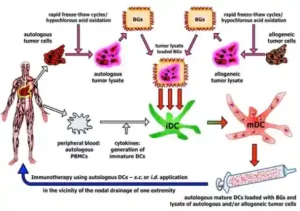
1.) Collection of DCs: Blood is drawn from the patient to isolate monocytes, a type of white blood cell that can differentiate into DCs. After the lab performs a liquid biopsy to determine the type of tumor and cancer. (See also Phase 1 section underneath)
2.) Cultivation and Activation: In the lab, these monocytes are cultured and exposed to specific antigens associated with glioblastoma cells. This process “educates” the DCs to recognize and attack glioblastoma cells.
3.) Injection into the Patient: The activated Dcs are then injected back into the patient, where they travel to the lymph nodes and stimulate the body’s T cells to target and destroy glioblastoma cells.
The Protocol for Glioblastoma Treatment in Germany
The program is generally structured to complement the standard of care (surgery, radiation, and temozolomide) rather than replace it.
Phase 1: Priming via Immunogenic Cell Death (ICD)
The goal of this phase is to kill tumor cells in a way that “alerts” the immune system. Standard chemotherapy often causes “silent” cell death, which the immune system ignores
- Modulated Electrohyperthermia (mEHT):This uses local radiofrequency fields to heat tumor tissue. It creates cellular stress and makes the tumor more vulnerable (Van Gool et al., 2020).
- Oncolytic Virus (e.g., Newcastle Disease Virus – NDV): Often administered alongside hyperthermia. NDV selectively infects and lyses cancer cells, releasing tumor antigens and “danger signals” (DAMPs) that trigger ICD.
- Timing: These 5-day treatment cycles are often integrated during the maintenance chemotherapy (Temozolomide) phase. (Not dendritic cell therapy)
Phase 2: Active Immunization (DC Vaccination)
Once the body has been “primed” by ICD, the Dendritic cell vaccine for glioblastoma is introduced to provide a specific “wanted poster” for the immune system.
- Monocytes are extracted from the patient’s blood, matured into dendritic cells in a laboratory, and loaded with tumor antigens from the oncolytic viro-therapy (ICD with Newcastle disease virus).
- Administration: The mature, “educated” DCs (e.g., the IO-Vac® vaccine) are injected intradermally. These cells migrate to lymph nodes to train T-cells to hunt glioblastoma cells throughout the brain.
Phase 3: Maintenance & Memory
The final phase focuses on preventing recurrence by maintaining long-term immune surveillance.
- Periodic hyperthermia and NDV sessions continue to target any emerging resistant clones.
- Booster Vaccines: Administered months later to strengthen the “memory” response of the T-cells
What the Evidence Shows — and What It Doesn’t
We think you deserve a straight answer about how well a dendritic cell vaccine for glioblastoma actually works, because much of what’s published online overstates it. Here is the honest picture.
There are encouraging signals. Several smaller trials and pooled analyses have reported longer survival when a dendritic cell vaccine is added to standard care. Meta-analyses combining these studies have found an association with improved overall survival — roughly a 30% reduction in the relative risk of death in some pooled estimates — along with a trend toward delayed progression. The vaccine is also consistently reported as well tolerated, with side effects that are usually mild and serious complications being rare.
But the evidence is not conclusive, and it’s important to understand why. Most of these studies are small, early-phase, or differ from one another in design, which makes the results hard to compare. To date, no Phase III trial has cleanly proven a survival benefit using a rigorous randomized design.
The largest and most discussed study — the DCVax-L trial — reported median survival of around 19 months from randomization, but it drew serious criticism from neuro-oncologists over its methods: it changed its primary endpoint partway through, took many years to enroll patients, and compared treated patients against an external historical group rather than a true internal control. Those are not minor footnotes; they mean the trial could not give a definitive answer about how well the vaccine works. We link the published critique below so you can read it yourself.
So where does that leave a patient today? A dendritic cell vaccine for glioblastoma is best understood as promising and worth exploring for the right candidate — not a proven cure, and not a substitute for standard treatment. It may offer the most value when tumor burden is low and when it’s combined with, rather than instead of, the established care your oncology team provides. For some patients it may be a reasonable option to consider; for others it may not be appropriate at all.
Our commitment is simple: we’ll tell you honestly where you fall, based on your medical records, even when the honest answer is that this vaccine isn’t the right fit for your situation.
Is dendritic cell therapy available in the US or UK? Is dendritic cell therapy approved by the FDA? Not yet.
1. Immunogenetics and Viro-therapy: A New Angle on Glioblastoma
2. Newcastle Disease Virus and Glioblastoma, Explained Simply
Glioblastoma (GBM) is one of the most aggressive brain cancers known. It grows quickly, spreads into surrounding brain tissue, and is difficult to remove completely with surgery.
Traditional treatments, like radiation and chemotherapy, can help slow its growth but often cannot completely stop it. Because of this, scientists have been developing new strategies that use the patient’s own biology and the natural behavior of viruses to attack cancer cells in smarter, more targeted ways.
Two exciting areas in this field are immunogenetics and cell-death viro-therapy, especially using a virus called Newcastle disease virus (NDV).
How Oncolytic Virotherapy Attacks Cancer Cells
Viro-therapy is a type of treatment that uses harmless or modified viruses to infect and kill cancer cells. These are called oncolytic viruses .Normal cells have defense mechanisms that stop viruses from taking over, but cancer cells, because of their damaged DNA and abnormal behavior are less protected.
Oncolytic viruses take advantage of this weakness: they selectively enter cancer cells, multiply inside them, and eventually cause the cells to burst. This is known as oncolytic cell death.
Even better, when cancer cells burst, they release signals that alert the immune system. This turns the tumor into a kind of “vaccine,” attracting immune cells to the area and helping them recognize cancer cells more effectively.
What Is Immunogenic therapy with Newcastle disease virus?
Immunogenetics is the study of how our genes influence our immune system, and how the immune system responds to disease. In cancer research, immunogenetics helps scientists understand why some tumors escape the body’s natural defenses and why immune-based therapies work better for some patients than others.Glioblastoma is known for creating an environment in the brain that suppresses the immune system. It releases signals that make immune cells “stand down,” so they don’t recognize the tumor as dangerous. Immunogenetic therapy aims to break this barrier.
How Immunogenetics Helps in GBM Treatment
Understanding the tumor’s genetic profile:
Every glioblastoma has a unique set of genetic mutations. These mutations can influence how visible the cancer is to the immune system. Scientists use immunogenetics to identify which mutations may produce “flags” (called neoantigens) that immune cells could target.
Enhancing immune recognition:
With this genetic information, researchers can design personalized strategies that help the immune system recognize cancer cells more clearly. Some approaches involve training immune cells to detect these neoantigens, while others adjust the immune response to be more active against the tumor.
Improving response to viro-therapy:
Immunogenetics also helps determine how a patient’s immune system will react to therapeutic viruses. Some people’s genetic makeup may cause their immune system to rapidly clear the virus before it can work on cancer cells; others may allow it to replicate long enough to kill tumor cells.
Newcastle Disease Virus: Why Researchers Are Studying It in Cance
One of the most studied oncolytic viruses for glioblastoma is Newcastle disease virus (NDV). This virus normally infects birds, not humans. In people, it causes little to no illness. But for reasons scientists are still learning about, NDV has a strong preference for infecting and killing cancer cells rather than healthy ones.
Why NDV Works Against Cancer?
Selective for cancer cells:
Cancer cells have weak antiviral defenses, so NDV can easily replicate inside them. Healthy cells block the virus quickly and stay safe.
Triggers strong immune reactions:
NDV infection causes cancer cells to release “danger” signals. These signals attract immune cells, which then begin attacking nearby tumor cells—even those not directly infected by the virus.
Stimulates “immunogenic cell death”:
Hence, when NDV causes a tumor cell to die, it does so in a way that is very noticeable to the immune system. This makes the immune response stronger and more targeted.
Works well with other therapies:
NDV can enhance the effects of radiation or immunotherapy by making tumor cells easier for the immune system to detect.
How NDV Viro-Therapy Works in Glioblastoma
Researchers typically deliver NDV directly into the tumor or inject it into the bloodstream. Once the virus reaches the tumor by liquid biopsy:
1.) The virus enters glioblastoma cells. Because these cells have weakened antiviral defenses, NDV can quickly take over.
2.) The virus replicates. As it multiplies, it stresses the cancer cell from the inside.
3.) The cell bursts.
This releases new virus particles (which go on to infect more cancer cells) and danger signals that alert the immune system.
4.) The immune system joins the attack.
Immune cells begin targeting the virus-infected tumor cells and then broaden their attack to include uninfected cancer cells that share similar markers. This combined effect direct viral killing plus immune activation makes NDV a powerful potential tool.
What is the most promising treatment for glioblastoma?
Effective Dendritic Cell Therapy– ImmunotherapyThe treatment with dendritic cell vaccine for glioblastoma in Germany is often used when conventional therapies are unsuccessful or never used. However, this was shown, for example, in the cases of glioblastoma, prostate cancer, pancreatic cancer, ovarian cancer, and malignant melanoma. As a result, dendritic cell therapy is most promising if there are only a few tumor cells.
Comprehensive Immunotherapy for Glioblastoma Treatment
Immunotherapy, including dendritic cell therapy, is gaining traction as a viable treatment option for newly diagnosed and recurrent glioblastoma in Germany. German clinics are known for their rigorous scientific research and advanced clinical trials.
Hence, patients from around the world come to Germany to benefit from these innovative treatments, which offer hope for better outcomes and improved quality of life.
Today, we know that the immune system of patients with a low tumor mass is often still much more efficient than that of patients with a high tumor load. The sooner dendritic cell therapy with immunotherapy begins, the more successful it might be. However, to see if you are a candidate for the treatment with dendritic cell vaccine for glioblastoma, forward your medical reports to us: here.
Medical conditions that can be treated by dendritic cell therapy:
- Breast cancer
- Cervix and Uterus carcinoma
- Lung cancer and lung carcinoma
- Stomach cancer
- Pancreatic cancer
- Prostate cancer
- Stomach cancer
Indications that can be treated by dendritic cells – Immunotherapy:
- Glioblastoma
- Sarcomas
- Ewing sarcoma
- Ovarian cancer
- Liver cancer
- Bladder carcinoma
- Colon cancer
Who Is a Good Candidate for a Dendritic Cell Vaccine for Glioblastoma?
Not everyone with glioblastoma is a suitable candidate, and being honest about that is part of how we work. A dendritic cell vaccine tends to be most worth considering when several of the following apply:
Lower tumor burden. The immune system generally copes better when there is less tumor to fight. Patients who have already had maximal safe surgical removal — leaving little visible residual tumor — are typically in a stronger position than those with a large, bulky tumor still in place. As a rule, the smaller the remaining disease, the more a vaccine has a realistic chance to work.
Used alongside or after standard care, not instead of it. The vaccine is studied as a complement to the Stupp protocol — surgery, radiotherapy, and temozolomide — not as a replacement. The most reasonable point to consider it is once standard treatment is underway or completed, where it may help the immune system maintain pressure on any remaining cancer cells.
Good performance status. Candidates who are still relatively active and independent in daily life — able to care for themselves and move around with little or no help — tend to tolerate treatment better and are more likely to mount a meaningful immune response. Patients who are very frail or rapidly declining are usually less suitable, and we’ll say so directly.
Available tumor tissue or a workable plan to obtain it. Because the vaccine is personalized to the features of your own tumor, having tumor material from surgery, or a feasible way to obtain it, matters for whether the approach is even possible.
Realistic expectations. The best candidates are those who understand this is a promising but unproven option being added to standard care in the hope of improving the odds — not a guaranteed cure. That clarity tends to lead to better decisions for everyone.
If you recognize your own situation in several of these points, it’s worth having your case looked at properly. The only way to know whether a dendritic cell vaccine for glioblastoma is appropriate for you is an individual review of your medical history, imaging, pathology, and current treatment plan.
Send us your medical reports and we’ll give you an honest assessment — including whether this approach makes sense in your case, and whether it doesn’t. There’s no cost to that first review, and no pressure either way.
The Bottom Line on Dendritic Cell Therapy for Glioblastoma
Immunotherapy for glioblastoma is changing how we think about treating a glioblastoma, one of the most aggressive brain tumors. Among the many approaches, dendritic cell (DC) therapy stands out as one of the most hopeful.
However, DCs are like messengers in the immune system—they help “teach” the body to recognize and attack cancer cells. In glioblastoma, which often manages to hide from the immune system, this can make a big difference.
Although, over the past few years, the treatment of glioblastoma with dendritic cells has gained traction thanks to better understanding of how to personalize treatment. Doctors can now create vaccines using a patient’s own tumor material, helping their immune system better target the cancer.
When used alongside surgery, radiation, or chemotherapy, this approach can boost the body’s natural defenses without overwhelming it.
As a result, other immunotherapies, like checkpoint inhibitors and CAR-T cells, are also being explored, but glioblastoma has proven to be a tough challenge. What makes DC therapy special is its potential to “wake up” the immune system in a safer, more controlled way.
While this isn’t a cure yet, the progress is encouraging. Dendritic cell therapy in combination with immunotherapy is offering patients and their families new reasons to hope—something that’s been long overdue in glioblastoma care.
Glioblastoma is a formidable foe, but advances in comprehensive immunotherapy for glioblastoma offer new hope. The treatment with dendritic cell vaccine for glioblastoma in Germany is at the cutting edge of medical innovation, providing personalized, targeted, and potentially long-lasting solutions.
For patients seeking the best care, GermanyHealth stands out as a top choice, offering comprehensive support and access to the finest medical facilities and expertise in the field of treatment of glioblastoma with DCs and oncolytic vino-therapy in Germany.
By choosing to pursue immunotherapy and the treatment of glioblastoma with DCs in Germany, patients can take advantage of the latest advancements and receive world-class care that could make a significant difference in their treatment journey.
This personalized approach could revolutionize the treatment with dendritic cell vaccine for glioblastoma and comprehensive immunotherapy for glioblastoma and improve outcomes for patients.
What the Clinical Evidence Shows So Far
Clinical trials are ongoing to evaluate the safety and efficacy of immunotherapy for glioblastoma. Early results have shown promise, with some patients experiencing prolonged survival and improved quality of life. Researchers are continually refining the process to enhance the effectiveness of this therapy and reduce potential side effects.
Trial watch: Dendritic cell (DC)-based immunotherapy for cancer
DCs and immunity against cancer
Antitumour dendritic cell vaccine in a priming and boosting approach
Final results of brain cancer glioblastoma clinical trial
Dendritic Cell Vaccine for Glioblastoma: Road to success or death end
The Complexity of Malignant Glioma Treatment
Let’s look into future:Many clients ask us about the study which going on in the UK with “Autologous tumor lysateloaded dendritic cell“. Here is a comment about the clinical trial for DCVax-L (…It is therefore disappointing that due to key methodological limitations, the DCVax-L trial ultimately failed to provide sound conclusions about the potential efficacy of such approach for patients with glioblastoma…)
What Does Oncolytic viro-therapy and Dendritic Cell Therapy in Germany Cost?
Here’s the cost section with a real range built around the €65K starting figure you gave.What Does a Dendritic Cell Vaccine for Glioblastoma Cost in Germany?
Costs depend on the specific protocol, the number of cycles needed, and your individual medical situation — but you shouldn’t have to send your records just to get a rough idea of the scale involved. Here is honest guidance on what to expect.
A complete program generally involves a minimum of two dendritic cell vaccine cycles, often combined with other elements such as oncolytic virotherapy (Newcastle Disease Virus) and, in some protocols, checkpoint inhibitors. A full combined program of this kind typically starts at around €65,000, and the total can rise from there — generally into the €65,000–€150,000+ range — depending on the number of cycles, which therapies are included, the laboratory work involved in personalizing the vaccine, and the length of your stay.
A few things worth understanding about what drives the cost:
1.) The protocol. A dendritic cell vaccine on its own costs less than a combined program that adds virotherapy and checkpoint inhibitors. More components mean higher cost.
2.) Number of cycles. Two cycles is a typical minimum; some patients are advised to have more, including booster doses later, which adds to the total.
3.) Personalization and lab work. Because the vaccine is made from your own cells and tumor profile, a significant part of the cost is the specialized laboratory processing involved — this is not an off-the-shelf treatment.
Practical costs: Travel, accommodation, and any support services are usually additional unless bundled into a package.
We’re giving you these figures up front because we think hidden pricing has no place on a medical page. The numbers above are a realistic guide, not a quote — your actual cost depends on what’s clinically appropriate for you.
However, to receive a clear, itemized estimate for your specific situation, you’re welcome to send us your medical reports, and we’ll set out exactly what a recommended program would involve and what it would cost.
In order, to get your individual cost estimate for immunotherapy for glioblastoma, we kindly ask that you send us your medical reports here.
Navigating a Glioblastoma Diagnosis: A Guide for Patients and Families
Receiving a diagnosis of glioblastoma can be overwhelming. It’s important for patients and their families to stay informed about the latest treatment options and to seek out the best care possible. GermanyHealth helps international patients navigate the complexities of receiving treatment in Germany. They offer a range of services to ensure that patients receive the highest standard of care.
GermanyHealth: Your Partner in the treatment with Dendritic Cell Vaccine for Glioblastoma in Germany

How to Arrange Your Treatment in Germany: Step by Step
Germany is renowned for its advanced medical treatments and state-of-the-art facilities, making it a top destination for patients seeking cutting-edge therapies like comprehensive immunotherapy for glioblastoma. One of the leading organizations in this field is GermanyHealth.
Our offer includes all from A to Z including transportation if you need it. Hence, for a remote second opinion, book here. However, if you have high demand, we recommend booking our VIP Service Germany.
Also our patient service provides comprehensive support for international patients seeking treatment with dendritic cells for glioblastoma treatment in Germany.
- Expert Consultation and Treatment Planning: We provide expert medical consultation to determine the most appropriate treatment plan for each patient with a glioblastoma to get the appropriate dendritic cell therapy.
- Hospital and Clinic Coordination: We arrange treatment at some of Germany’s best hospitals and clinics specializing in the treatment with dendritic cell vaccine for glioblastoma. Of course, you receive our onside service as well.
- Travel and Accommodation Assistance: We assist with travel arrangements, visa applications, transportation in Germany, and accommodation, ensuring a smooth and stress-free experience.
- Ongoing Patient Support: We offer continuous support throughout the treatment process, including follow-up care and communication with the clinic. Hence, we provide follow up service after you have left back home.
“Send us your reports for an honest assessment of whether this therapy makes sense for your situation”.

Speak With Our Team About Treatment Options in Germany
Call or WhatsApp: 0049 151 5660 7300